Calankan qaayaha lahoow
qudheyda badhkeediyoow
intaan kuu qabo jacayl
qiyaas kuma koobi karo
hadday caanuhu qubtaan
illayn dabadood la qabay
waxaan diray qaylo dhaan
Saadaal wacan baan qabaa
sidaa ku-calool qabow ……. Dr. Abdirahman Bayle
Let the beauty we love be what we do.
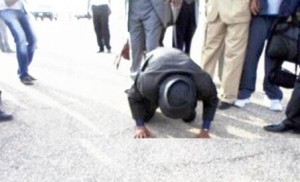
There are hundreds of ways to kneel and kiss the ground (Rumi)
Some
of us may frown upon Samatar’s sudden and unexpected visit to Hargeisa.
The visit may be interpreted as a sellout of his Unionist position and
a betrayal of his Hiil-Qaran party principals. Hiil-Qaran after all
stood for “Coming to the aid of the failed State of Somalia as a whole”.
After he disembarked from the plane that ferried him and his
entourage to Hargeisa, he knelt and kissed the ground in a gesture of a
long lost son who finally came back home. Sadly, he was greeted with
the flag that he stood against for a very long time. The Somaliland flag
that represents division and secession was unceremoniously draped
around his shoulders as if to remind him that he is now in a land that
does not believe in the blue Somali flag: a flag that sports a five
pointed star representing greater Somalia for which Samatar and other
unionists like him campaigned most of their adult lives.
Samatar grew up with the dream of a united Somalia and he continued
pursuing that dream for most of his journalistic and academic career.
The professor vehemently wrote and spoke against the secession of his
native Somaliland and decided to steer clear from the secessionist state
where he could not even visit his mother for fear of being
incarcerated.
The current visit is probably his first since the collapse of the
Somali State and it seems that he may have received assurances
guaranteeing his well-being. There is a sharp contrast between the
treatment he received after campaigning hard to be elected as Somalia’s
president; and the treatment that Boqor Rabi, who merely travelled to
Mogadishu, received. The latter languishes in a prison serving a two
year term while Samatar has been welcomed in Hargeisa although not to
the level that he expected as he later admitted in his birth place,
Gabilay, a city not far from Hargeisa. His sudden visit comes in the wake of a series of town hall meetings in
Minnesota where he attacked the Federal Government of Somalia in
Mogadishu and expressed his disappointment with the South after
developing a feeling of being an outsider who was deliberately pushed
aside in his attempt to run for the highest office in Somalia.
Samatar and his younger brother Abdi invested heavily in Hiil-Qaran
and had high hopes of standing out in the race for Villa Somalia.
Unfortunately, Samatar failed to inspire a parliament populated by
opportunistic individuals who valued monetary gains over knowledge and
leadership. He garnered a measly eight votes and joined the prestigious
club of highly qualified also-rans that included Dr. Badiow, Dr.
Abdi-Weli Gaas and Dr. Abdirahman M. Hashi, other heavyweights who
lacked a deep purse like him. It is public knowledge that thousands of
dollars changed hands in the election of the current president who
cannot compete against Samatar and the other candidates when it comes to
leadership, charisma and knowledge. But what else could be expected
from a process based on a mixture of clan politics and foreign meddling.
The sad thing though is how Samatar got affected by the process to the
extent of selling his soul to the secessionist enclave.
Regardless of the obvious flaws in the process of electing a Somali
president, which will hopefully be rectified if and when Somalia reaches
its goal of an election that does not rely on clan politics and the
infamous 4.5 formula, Samatar seems to have betrayed many who looked up
to him as a unionist who defended the blue flag. His first declaration
in Hargeisa was that Somaliland used to be a separate country before it
gained its independence from the British and voluntarily joined South
Somalia to form the Somali Republic. Such a statement uttered by a
highly qualified scholar is indeed worrisome and may signal a new
Samatar who may have turned his back on a long and illustrious unionist
legacy.
His declared intention of visiting all corners of Somaliland
including remote towns like Eirgavo may stem from his desire to gauge
the extent of the secession sentiment among the population of the former
British Somaliland and thus justify his new position. Hopefully he will
include Unionist bastions like Badhan, Las Qoray, Las Anod, Buhodle and
Taleh in his itinerary.
On a positive note, his visit may herald a new dialogue in former
British Somaliland between secessionists and unionists in which Dr.
Samatar, with his persuasive arguments, can paint a clear picture for
the Somaliland leaders: that they may have hit a brick wall in their
fruitless endeavor to seek world recognition and that it is about time
for a new strategy that brings together all Northern clans in a setting
like the famous “Gol Khaatumo” after convincing Silanyo to withdraw his
militia from all Unionist territories.
Short of that, Samatar will just become another frustrated
XaglaToosiye in Hargeisa even if he is offered the Foreign Affairs
portfolio in Somaliland as some analysts are predicting.
Ali H. Abdulla
aliegeh@gmail.com